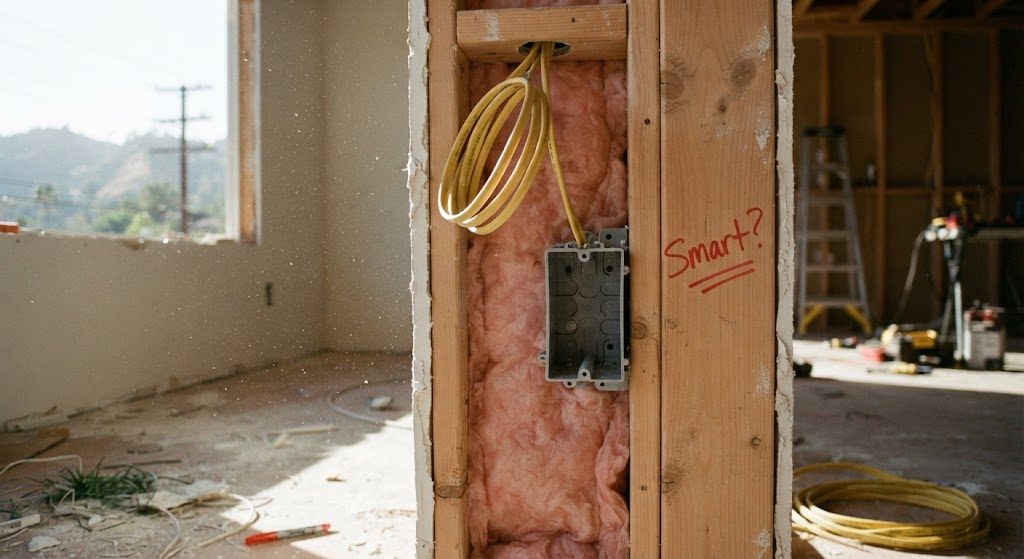
I walk every job site before drywall goes up. It's non-negotiable. I've been on at least 200 of these walks, and I always look for the same thing: the electrician's rough-in boxes. Specifically, I look for the switches. And every single time, I ask the same question to the general contractor or the homeowner standing next to me: "Did anyone tell the electrician which ones need to be smart?"
The answer, in about half of remodels and a surprising number of new builds, is no. The electrician was given a lighting plan with fixture locations and switch legs. They ran the Romex, installed the boxes, and followed code to the letter. They did their job. But nobody told them the house is supposed to be smart. That gap—between a standard electrical installation and a system-ready one—costs homeowners thousands in change orders, drywall patches, and compromised designs. And it starts with one unasked question.
Why Your Electrician Won't Ask
Standard residential electricians are trained to install standard switches. A single-pole switch needs a hot, a switch leg, and a ground. A three-way needs travelers. That's what they wire, day in and day out, and it works perfectly for a house with manual controls. The problem is that smart switches, dimmers, and keypads demand things a standard box often lacks: a neutral wire at the switch location, a deeper box for the electronics, and sometimes a dedicated low-voltage pathway for communication.
The Neutral Wire Misconception
The most common rough-in mistake I see is the missing neutral. Smart switches and dimmers need constant power to keep their radios and processors alive, even when the light is off. That requires a neutral wire in the switch box. Many older homes and some new ones wired to minimum code use switch loops that send the neutral directly to the fixture, bypassing the switch box entirely. If your electrician doesn't know you're installing smart controls, they might wire the switches without a neutral. Fixing that after drywall means pulling new cable through finished walls. That is not cheap, and it is not fast.
Box Depth and the Heat Problem
A smart dimmer is thicker than a $1 toggle switch. It has a heat sink, a circuit board, and a mass of wire connections crammed into the back. A standard 2-inch-deep single-gang box often can't accommodate a smart dimmer plus the required wires, especially in a three-way configuration with extra travelers. Code sets limits on box fill, and a box that's too small either violates code, damages the device, or both. Swapping a shallow box for a deep one before drywall takes an electrician ten minutes. After drywall, it takes a drywaller, a painter, and an electrician making a second trip.
The Pre-Construction Conversation That Saves You
You don't need to specify every smart device before rough-in. You do need to decide which switch locations will be smart, and you need to communicate that to the electrical contractor in a language they understand.
Mark the Plan, Then Mark the Walls
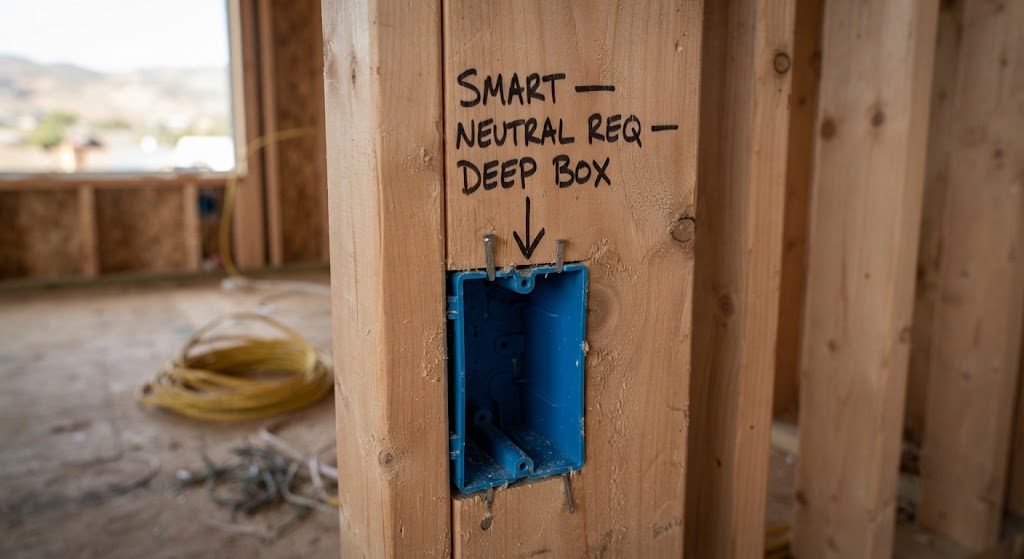
Start with a printed lighting plan and a highlighter. Every switch that will be a smart dimmer, a keypad, or an occupancy sensor gets marked in yellow. Walk the job site with the electrician and physically mark those boxes on the studs. I write directly on the stud in Sharpie: "SMART — NEUTRAL — DEEP BOX." It takes fifteen minutes, and it eliminates the single most expensive rework item in a smart home project.
Run Conduit to the Brain
While the walls are open, ask your electrician to run a 3/4-inch smurf tube from your structured wiring panel to a few strategic locations: the kitchen keypad location, the primary bedroom entry, and the living room media wall. That conduit gives you a future path for low-voltage control wiring or fiber without ever opening a wall again. It's a few dollars of plastic tubing that buys you decades of flexibility.
The electrician's job is to deliver a safe, code-compliant installation. Your job, as the homeowner or the system designer, is to make sure that installation can support the house you're actually building. That starts with a conversation most electricians won't initiate. Have it before the drywall goes up, and the smart home gets wired for the next twenty years. Miss it, and you'll spend the next twenty years wishing you'd grabbed that Sharpie.