There is a moment that happens about once a month in my line of work. I walk into a home for a consultation, and there's a camera mounted on the kitchen soffit, aimed directly at the island where the kids eat breakfast. The homeowner tells me they wanted to see the whole open-plan living space. What I see is a family eating cereal on a permanent video feed. They didn't think of it that way. Most people don't—until a guest asks, "Is that recording me right now?"
Interior cameras are the single biggest trust violation I see in residential security design. They're rarely malicious, but they're almost always unnecessary. In a properly designed system, the security of the interior comes from sensors that don't see anything. Exterior cameras handle the perimeter. Interior motion detectors and door sensors handle the inside. That separation keeps the house safe and the occupants unrecorded. Here's how I draw that line.
The Perimeter Principle
The first rule is simple, and I apply it to every project. Cameras belong on the perimeter, facing outward or down. The goal is to see the threat before it reaches a door or window. A camera mounted under the eave at each corner of the house, aimed at the approach, gives you a 360-degree view of anyone walking toward the structure. A video doorbell or a dedicated front-porch camera covers the most common entry point. A camera aimed at the driveway catches the delivery person, the unexpected car, and the teenager sneaking in past curfew.
Why Exterior Cameras Work Better
An exterior camera has a defined job: watch the boundary. It doesn't have to distinguish between a family member and a guest, because anyone crossing the property line is subject to the same basic level of observation. Paired with motion-activated lights and a local NVR that records 24/7, the perimeter becomes a hard target. The system doesn't need facial recognition or AI analytics. It needs a clear image, a timestamp, and enough storage to go back thirty days. That covers 99% of residential security scenarios without recording a single frame of family life inside the house.
Where Cameras Never Belong
I will not put a camera in a bedroom, a bathroom, or any room where someone might sleep or undress. That is a bright line. But I also strongly discourage cameras in any primary living area where guests gather—the living room, the dining room, the kitchen island seating area. These spaces are for conversation, meals, and leisure. A visible camera changes the emotional temperature of a room. It turns a host into an observer.
Sensors Do the Interior Job Better
The interior doesn't need cameras because other sensors already confirm occupancy and detect intrusion without recording anything. A door sensor on every exterior door and accessible window tells the system when an opening is breached. A motion detector in the main hallway, the stairwell, and the garage triggers an alert if movement is detected while the system is armed. Glass-break sensors near ground-floor windows and sliding doors cover the final entry vector. These devices tell the brain what it needs to know—something is happening, and it shouldn't be—without capturing an image or recording a sound.
Designing for the Guest's Eye
There's a second audience for your security system besides your family: everyone who visits. A house that makes guests feel surveilled is a house that people don't relax in. That matters. It matters for dinner parties, for holidays, for the friend who crashes on the sofa after a late night.
The Indicator Light Rule
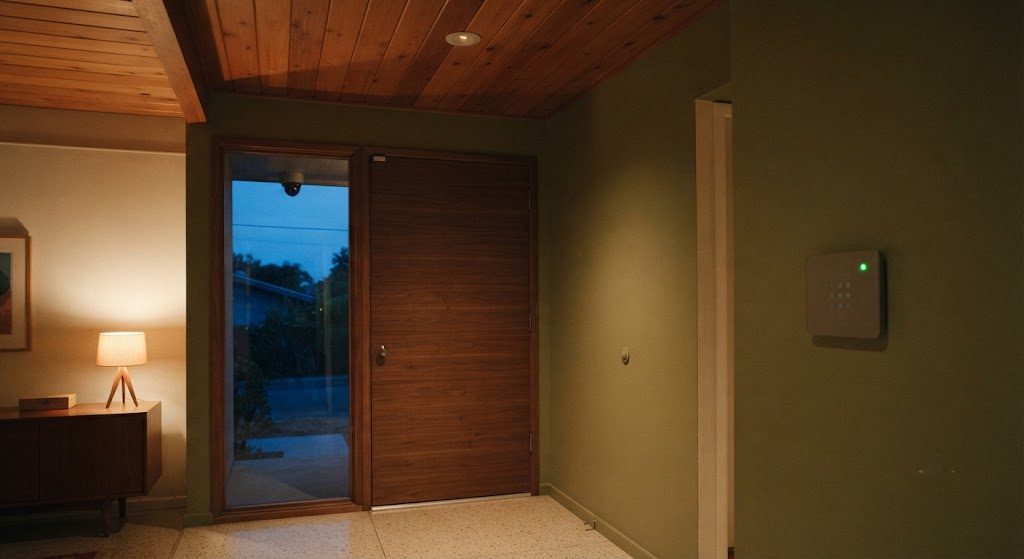
Every device that can observe or record should declare itself honestly. Exterior cameras get a small, steady indicator light visible from the approach—it says "this property is monitored" without screaming it. Interior motion sensors get a single LED that blinks once when triggered; it's a status indicator, not a recording light. Door sensors are entirely invisible. The goal is transparency without theatricality. A guest who looks for the system can see it. A guest who isn't looking doesn't think about it.
The Guest Mode Scene
In a fully integrated system, I program a "Guest Mode" scene that the homeowner can trigger from a keypad. It does several things at once. It disarms the interior motion sensors—so overnight guests can walk to the bathroom at 2 a.m. without triggering an alarm. It leaves the perimeter sensors and exterior cameras fully armed. It adjusts the entry lights to a warm 2700K at 30% to guide any late arrival. And it turns off the status LEDs on interior keypads in guest areas, so the house doesn't feel like a spaceship. The system is still working. It's just not performing.
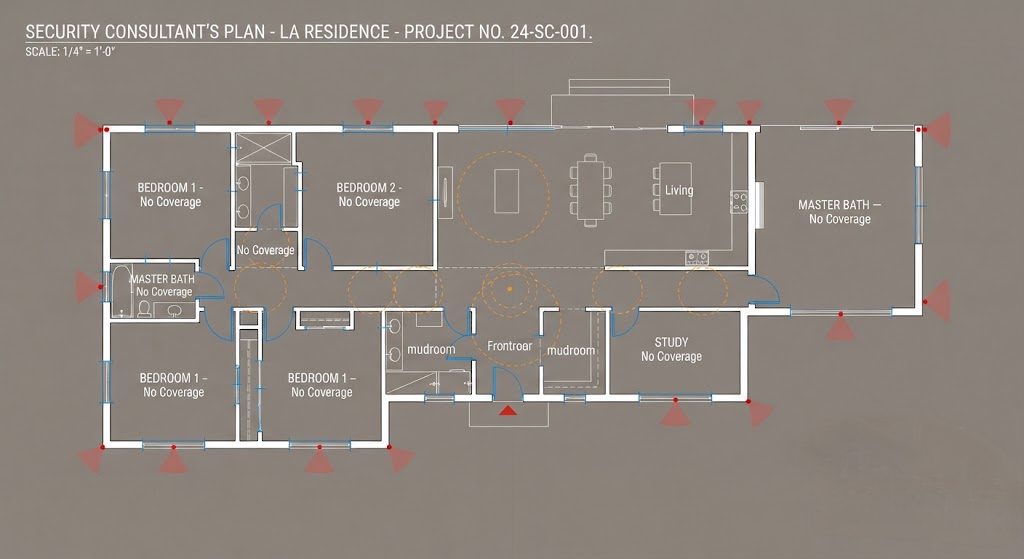
The security system that does its job well is the one nobody thinks about until it's needed. That requires restraint. Don't fill every soffit with a lens. Trust the sensors. Arm the perimeter. Let the inside of the house be private. Your guests will never mention it, and that's exactly the point.