

The demo always starts the same way. A salesperson walks into a staged living room, says "Alexa, movie night," and the lights dim, the TV turns on, the shades drop. The prospective client's eyes go wide. They imagine their own home responding to their voice, obeying commands like a starship computer. Then they live with it for a month.
After 200 homes, I can count on one hand the number of clients who still use voice control as their primary smart home interface after year one. The rest have migrated to something quieter: a keypad by the door, a schedule they forgot they set, a house that acts without being asked. Voice control is not the point of a smart home. It's a useful accessory for specific moments, and it's a terrible foundation for how you interact with the place you live.
Where Voice Control Fails
The problem isn't the technology. Speech recognition is remarkably good now. The problem is the context. A home is not a laboratory. It's full of competing sounds, multiple people, and moments where talking to a machine feels absurd or intrusive. Voice control fails on three fronts: speed, social friction, and reliability.
The Speed Problem
Saying "Alexa, turn on the kitchen lights to fifty percent" takes about three seconds if you nail the phrasing on the first try. Pressing a keypad button engraved "Kitchen" takes about half a second and works 100% of the time. Across 200 homes, I've watched the same behavioral pattern play out: people start with voice because it feels magical, then they migrate to the keypad because it's faster. The magic fades. The convenience remains.
The Social Friction Problem
No one wants to issue voice commands in front of dinner guests. It feels performative. It also fails when multiple people are talking, when the baby is sleeping, or when you're the first one awake and don't want to wake the entire household by announcing your intention to make coffee. A keypad is silent. A schedule is silent. Voice control demands an audience, even when no one else is in the room.
The Reliability Stack
Voice control requires a chain of dependencies: the microphone hears you correctly, the cloud service processes the utterance, the command routes back to the processor, and the processor executes the scene. If any link in that chain breaks—internet outage, cloud service degradation, a firmware update that reboots the smart speaker—the command fails. A keypad talks directly to the processor over a local network. It works when the internet is down. It works when the cloud is having an outage. It works at 3 a.m. when you're too tired to speak clearly.
Where Voice Control Actually Earns Its Place
I am not telling you to throw away your smart speakers. I have them in my own home. But they serve three specific functions, and I spec them for those functions and nothing else.
Timers and Information Queries
Setting a kitchen timer while your hands are covered in flour is the single best use case for a voice assistant. Asking for the weather while you're getting dressed is the second. Asking for a unit conversion or a quick fact check is the third. These are information tasks that don't involve the house doing anything physical. Voice assistants excel at them, and they always will.
Music and Audio Control
"Play John Coltrane in the kitchen" is a genuinely useful command. Music selection is a browsing task, and voice is faster than scrolling through a phone interface when you know exactly what you want. Whole-home audio systems that integrate with voice control for music selection make sense. But notice the distinction: voice is the music selector, not the lighting controller. The lights don't need browsing. They need a button.
The Real Interface Is a Keypad and a Schedule
I design every home with the assumption that the primary interfaces will be physical keypads and automated schedules. The keypads are engraved with scenes, not device names. "Morning," "Dinner," "Away," "Goodnight." Each one triggers a complex sequence across multiple subsystems, and each one requires exactly one press. No wake word. No phrasing. No confirmation chime.
The Schedule You Never Think About
The best smart home interaction is the one that doesn't require an interaction at all. When the shades drop at sunset without being asked, when the thermostat adjusts at midnight because the house knows you're asleep, when the entry lights come on because the deadbolt just unlocked—those are not commands. They're responses. The house is reading the situation and acting on your behalf. That's the opposite of voice control. Voice control means you're still managing the house, just with words instead of switches. A real smart home manages itself.
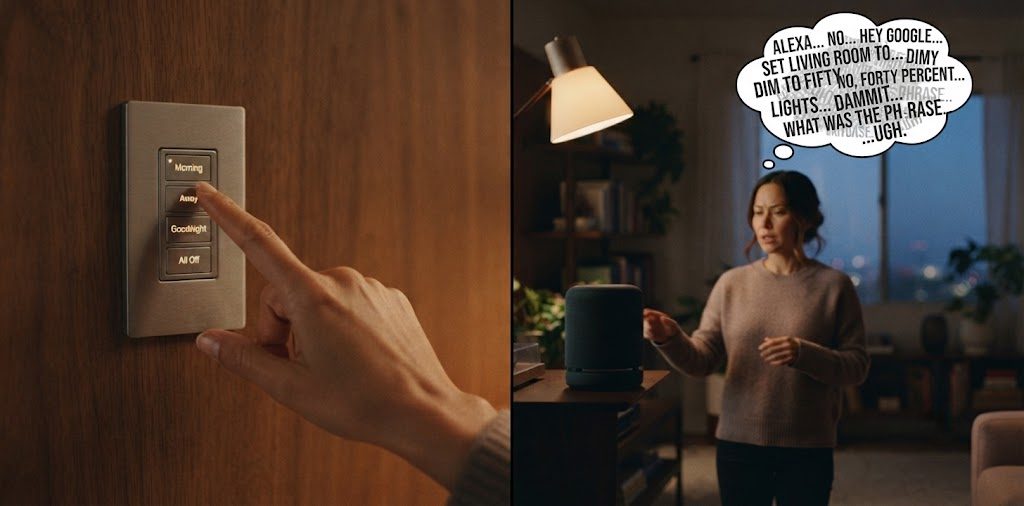
Voice control is a feature, not an interface. It's the backup singer, not the lead. In every project I design, the voice assistant gets a role: kitchen timer, weather reporter, DJ. The lead role—the way you actually talk to your house—belongs to a keypad on the wall and a schedule that's been running so long you've forgotten it's there. That's the smart home doing its job. No speaking required.