
I've sat through hundreds of manufacturer presentations. I've read the glossy one-sheets, watched the staged demos, and listened to the promises made in carpeted convention center booths. The language is always the same. "Seamless." "Intelligent." "Future-proof." "Works with everything." These words mean something very specific in a product manager's PowerPoint deck. They mean something entirely different when the drywall is up, the internet is down, and the client is standing in a dark kitchen wondering why the lights won't respond.
After 200 homes, I've developed my own internal translator. When I hear a sales pitch, I mentally replace the marketing language with what it actually means in a finished house, six months after move-in. Here are the five most common claims, decoded.
"Works With All Major Ecosystems"
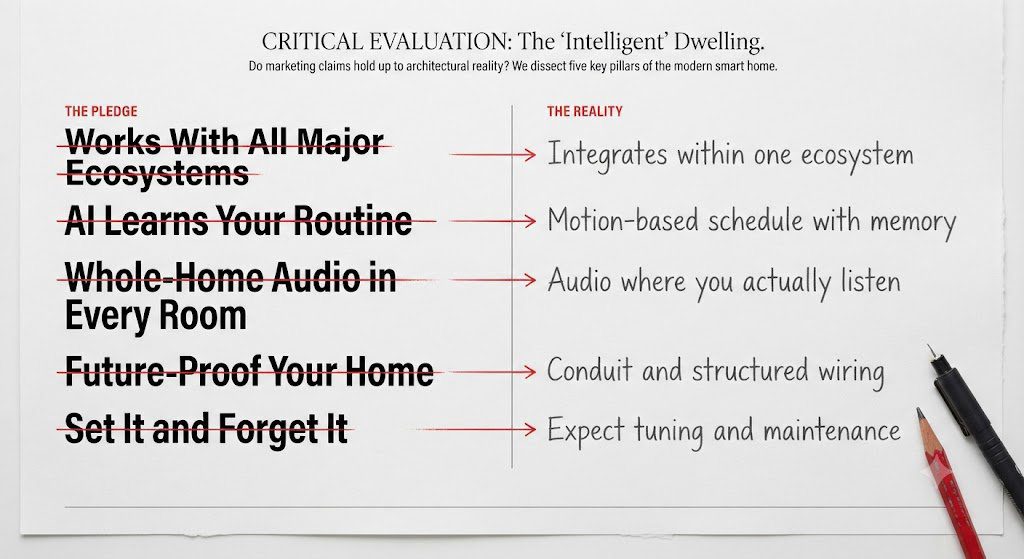
This is the most common promise in the smart home aisle, and it's the most misleading. What it actually means is that the device works with Amazon Alexa, Google Home, and Apple HomeKit at a basic level. You can turn it on and off with a voice command. You can probably control it from the manufacturer's app. What it does not mean is that the device will participate in scenes across different brands, report its status to a central processor, or behave predictably when the network hiccups.
What Actually Matters
Interoperability is not the same as integration. A light bulb that "works with Alexa" will turn on when you ask it to. A light bulb that's part of an integrated system will also trigger the thermostat when the room is occupied, notify the security system if it's on during an alarm, and follow a circadian schedule that coordinates with the motorized shades. The first one is a gadget. The second one is a component. The distinction is invisible on the box, and it's everything after installation.
"AI Learns Your Routine"
The phrase "AI" in residential smart home products almost always means a simple occupancy learning algorithm. The device tracks when motion is detected and builds a schedule based on historical patterns. After a few weeks, it starts turning lights on and off at roughly the times you've been in those rooms before. That's not artificial intelligence. That's a glorified timer with a memory.
The Real-World Failure Mode
The problem with occupancy learning is that it breaks whenever your routine breaks. If you stay home sick on a Tuesday, the system still thinks you're at work and puts the house into away mode. If you have houseguests, the schedule is wrong for a week and takes another week to unlearn. A properly commissioned system uses occupancy sensors for real-time response, not pattern learning. The lights come on because someone walked into the room, not because the processor thinks it's 6:15 p.m. and you're usually in the kitchen. That distinction determines whether the house works on a normal Tuesday and on the Tuesday when everything is different.
"Whole-Home Audio in Every Room"
This pitch sells speaker count. Sixteen zones. Twenty-four zones. An audio zone for every room, including the pantry. The marketing material shows a house where music follows you seamlessly, room to room, all day long. The reality, observed across 200 families, is that most people use three audio zones: the kitchen, the living area, and the primary suite. The rest play music twice a year during holiday parties.
What Actually Matters
The right question is not "how many zones?" but "where does your family actually listen to music?" In my experience, four to six well-placed zones cover the daily experience of nearly every household. The money saved on speakers in the laundry room and the guest bathroom should go to better amplification and proper in-wall speaker placement in the rooms that matter. More zones is not a better system. It's a larger line item on an invoice.
"Future-Proof Your Home"
Future-proofing is the most powerful sales word in this industry. It suggests that what you buy today will still work a decade from now, and that the house will adapt gracefully to new technology. The truth is more complicated. A properly designed infrastructure—conduit, structured wiring, a deep equipment rack—is genuinely future-proof. The devices themselves are not.
The Infrastructure Difference
A Cat6 cable run today will carry 10-gigabit Ethernet. The processor you install today will be obsolete in five to seven years, same as any computing device. The difference is whether the infrastructure lets you swap that processor in an afternoon without cutting a single hole in the drywall. A house with smurf tube to every keypad location, a dedicated rack room with spare capacity, and a structured wiring panel with labeled home runs can accept a new processor, a new audio format, or a new security standard with minimal disruption. That's future-proofing. Everything else is a bet on a product roadmap you don't control.
"Set It and Forget It"
This is the promise that sells smart homes: the system is so intuitive, so automatic, that you'll never think about it again after the first week. It's also the promise that creates the most service calls. Every smart home system requires maintenance. Firmware updates, device battery replacements, and the occasional scene adjustment as the family's routines change over time. "Set it and forget it" implies that a smart home is an appliance. It's not. It's a living system that adapts to the people inside it.
What Actually Happens After Handover
In the first month after commissioning, every client requests changes. A scene is too bright at night. The bathroom motion sensor is too sensitive. The shade schedule needs to shift later in summer. These are not failures. They are the system being tuned to actual life, not the brief we wrote before the family moved in. A good integrator builds in the expectation of adjustment—and the documentation to make those adjustments fast and reversible. A system that was truly "set and forget" would be a system that never quite fit.
The marketing language won't change. Manufacturers need to sell products, and products need compelling stories. But the homeowner who learns to translate the pitch—who reads "AI-powered" and thinks "schedule with a learning curve," who reads "seamless" and asks "seamless within what ecosystem?"—that homeowner makes better decisions. The smartest clients I've worked with don't ask me about features. They ask me what those features will feel like on a Tuesday evening, three years after the installer leaves. That's the only translation that matters.