
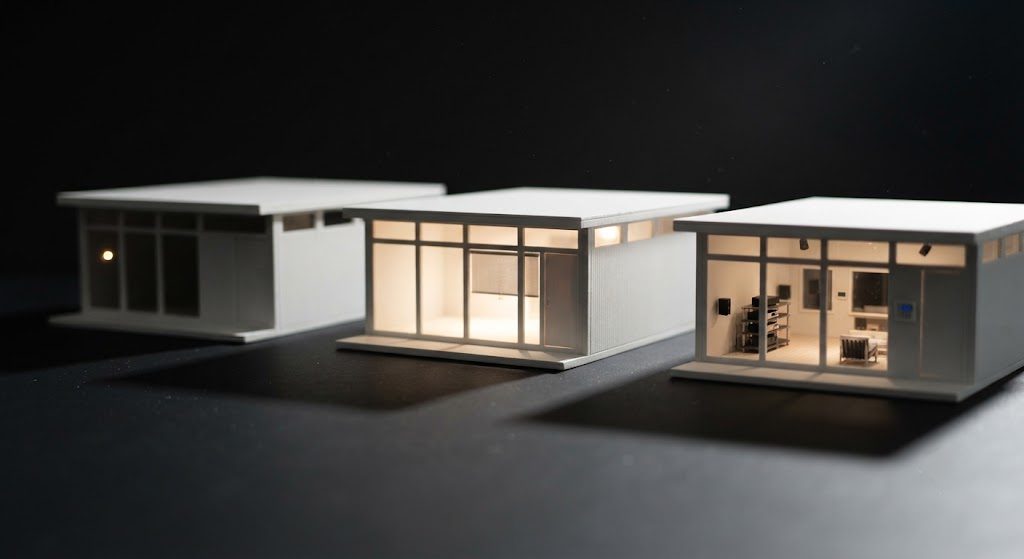
Most clients arrive at my office with a number in their head. Most of those numbers are wrong. Not too low—just untethered from what things actually cost and what the money actually buys. I've stopped starting with budgets. I start with tiers.
A tier is not a price bracket. It's a description of what the house will do for you on a Tuesday evening, and what it won't. Over 200 projects in LA County, I've learned that almost every homeowner lands in one of three categories. I call them Entry-Level, Thoughtful, and No-Compromise. The names aren't about cost. They're about scope, integration depth, and the daily experience of living in the house.
The Entry-Level Smart Home
This is the smart home for someone who wants the greatest hits—the features that deliver the most noticeable quality-of-life improvement for the least complexity. The Entry-Level tier is not "cheap." It's targeted. Every dollar goes to a subsystem that changes how the house feels every single day.
What's Included
The Entry-Level package centers on three subsystems: lighting control in the primary living spaces, motorized shades on the most problematic windows, and a proper network backbone. The lighting uses wireless dimmers and a handful of keypads—typically at the garage entry, the kitchen, and the master bedroom. The shades cover west-facing glass or street-facing windows where privacy matters. The network is a wired router, a PoE switch, and two hardwired access points. No zones. No whole-home audio. No security integration beyond a video doorbell.
The Daily Experience
In an Entry-Level home, you walk in from the garage and press one button. The kitchen lights come on at 70%, the living room pendants glow at 40%, and the hallway to the bedrooms is lit just enough to navigate. At sunset, the west shades drop automatically. The Wi-Fi works in every room, and you never think about rebooting the router. You still have manual switches in the guest room and the laundry. You still use an app for music on a portable speaker. But the core of the house—lighting, heat management, connectivity—works without friction.
What You're Not Getting
You don't get whole-home audio. You don't get HVAC zone control or integration with the security system. Your scenes are limited to the keypads you installed. Expansion later means adding devices and reprogramming, which costs more than installing them during construction. The Entry-Level tier is a foundation, not a finish. It's designed for the homeowner who wants the house to work better now and can add more later.
The Thoughtful Smart Home
This is where most of my clients land. The Thoughtful tier covers lighting across every room, motorized shades on every window that gets direct sun, zoned climate control, a security system with integrated sensors, and whole-home audio in the rooms people actually gather in. The network is robust—a managed switch, four or more hardwired access points, VLANs for IoT and camera traffic.
The Daily Experience
In a Thoughtful home, the house anticipates you. The entry scene triggers when the deadbolt unlocks—lights to a warm 3000K, thermostat adjusting to occupied mode, the kitchen audio zone playing softly. The "Goodnight" button by the bed shuts down the entire house except a path light to the bathroom and the nursery camera feed. The shades track the sun all day, closing on west windows at 3 p.m. and opening again at sunset. The security system arms itself at midnight and disarms when the first person wakes up. You don't open an app for any of this. The keypads do the work.
What You're Not Getting
You don't get a dedicated home theater, unless one room was designed for it during construction. You don't get energy management—no solar monitoring, battery integration, or EV charger scheduling. Your audio zones cover the main living areas but not the guest bedrooms, the garage, or the backyard. The system is deep and polished, but it has edges. There are rooms where you still use a manual switch, and that's intentional—the budget went to the spaces that matter most, not to total coverage.
The No-Compromise Smart Home
This is the full system. Every room gets lighting control, keypads, and audio. Every window gets a motorized treatment. The HVAC is fully zoned with remote sensors in every bedroom and occupied space. The security system includes perimeter cameras, interior motion sensors, and glass-break detectors on every accessible opening. Energy management ties in solar production, battery storage, and EV charging. The rack room is a conditioned, dedicated space with a UPS that keeps the entire system running through extended outages.
The Daily Experience
In a No-Compromise home, you never touch a manual switch. You never open an app unless you want to check the solar production or review camera footage from a delivery. The house runs on schedules, sensors, and scenes that were tuned over weeks of commissioning. The lights shift color temperature throughout the day. The audio follows you from room to room if you want it to. The guest house operates independently but reports to the same app. When you leave, one button press secures every subsystem. When you return, the house wakes up before you reach the door.
What You're Still Not Getting
Perfection. Every system has bugs during commissioning. Every homeowner finds a scene they want adjusted after month three. The difference with No-Compromise is that the infrastructure can handle the changes—the processor has headroom, the network has capacity, the rack has space. You're paying not just for what the house does today, but for what it can do in ten years without opening a wall.
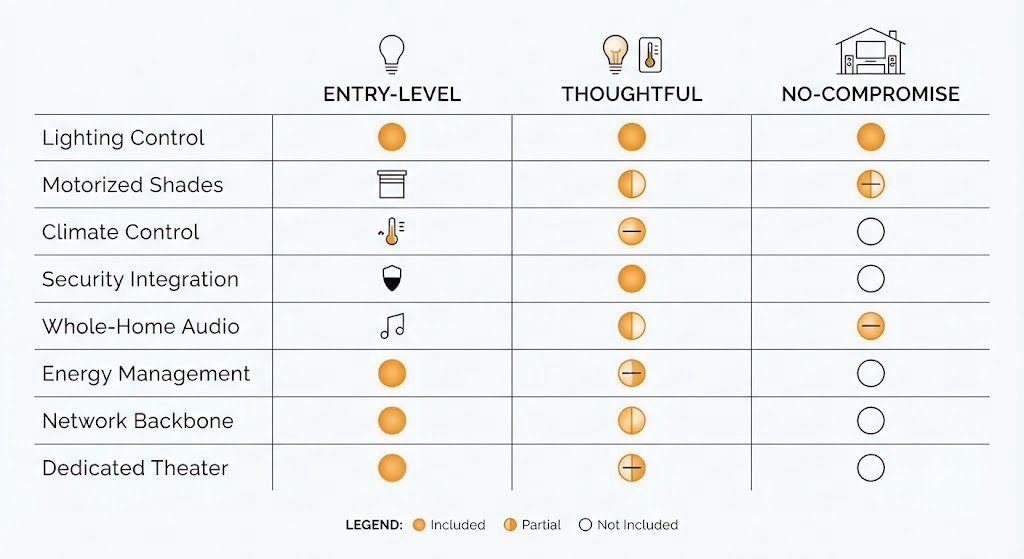
The right tier is the one that matches how you actually live. I've had clients with the budget for No-Compromise choose Thoughtful because they didn't want technology in every room. I've had clients start at Entry-Level and add subsystems every year for five years. There's no wrong answer, but there is a wrong question. Don't ask what a smart home costs. Ask what you want the house to do on a Tuesday evening, and then build the tier that delivers it. The budget will follow from the brief, not the other way around.