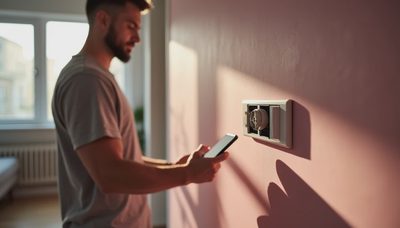
When a home is in rough-in or renovation, a motion sensor light switch can solve a very specific problem: the space is used often enough that people expect light, but not so continuously that a manual switch feels worth the friction. I use them in circulation spaces, utility rooms, and garages because those rooms reward predictability. Put one in the wrong room, though, and you create the opposite effect: lights that flip on when someone is trying to relax, sleep, or watch a movie. The trick is not the sensor itself. It is matching the control method to the way the room actually behaves at 7 a.m., 7 p.m., and 2 a.m.
Where the switch earns its keep
A wall sensor makes sense in places where people enter briefly, carry things, or have hands full. Hallways, laundry rooms, garages, closets, pantry spaces, and stair landings are the obvious wins. In those rooms, the best control is the one you never have to think about. The light comes on when you need to see the floor, the shelf, or the step, and it shuts itself off when the space is empty. That sounds small, but in a house with repeated use, those small moments are what determine whether a system feels helpful or annoying. I like to think in terms of friction: if a room is crossed ten times a day, the savings is not electricity, it is attention.
The strongest installs usually happen in spaces where the use pattern is simple. A hallway that used to stay dark until someone fumbled for a paddle now comes on as they approach and fades after a quiet delay. A laundry room no longer depends on whether the person carrying a hamper has a free hand. A garage feels safer because the first step inside is not a guess. That is where a sensor earns trust. Once people trust it in those spots, they are more open to using it in the rest of the house where it makes sense.
Occupancy mode versus vacancy mode
With a motion sensor light switch, occupancy mode turns the load on automatically, while vacancy mode requires a manual press before the sensor can turn it back off. In practice, vacancy mode is often the calmer choice in bedrooms, bathrooms, and guest spaces because it avoids the surprise of a light snapping on when somebody shifts on the bed or opens a door at night. Occupancy mode is better in places where hands are full and nobody wants another step, like a laundry room with a hamper in both arms. The reason this matters is that homeowners do not abandon automation because the idea is bad; they abandon it because a room keeps doing one weird thing.
The choice also affects how a house feels after the honeymoon period. People tolerate a bright idea that works most of the time. They stop using a control that behaves like it is guessing. In a hallway, a quick automatic response feels natural. In a bathroom used at night, the same behavior can feel rude. That is why I push clients to think about the room in plain language before they think about devices. Is the room crossed, occupied, lingered in, or shared with someone who may be asleep nearby? Once you answer that, the control mode stops being abstract.

What usually fails after year three
The year-three problems are usually not electrical. They are behavioral. Someone changes the furniture, a door starts staying open, a pet wanders through the detection zone, or the timeout was set so aggressively that the room goes dark while someone is still working. In a sensor-based installation, the hidden enemy is bad calibration. Too sensitive and every pass-through becomes a false trigger. Too short a delay and the room feels impatient. Too long and the savings disappear. I have also seen switches placed where the only motion is directly at the door, which means the sensor sees a narrow slice of the room and never learns how the space is used. That is why the rough-in conversation matters more than the trim style.
Another issue is that people assume the room will keep behaving the same way forever. It will not. Furniture moves. A desk gets added. A child starts using a closet as a staging area. A guest room becomes an office. If the control was chosen only for the original floor plan, the room can become awkward fast. The fix is not to avoid sensors altogether. The fix is to install them where the use pattern is stable and to set expectations that they are part of the room design, not a decorative afterthought.
Wiring decisions that should happen before drywall
A motion sensor light switch is easiest to specify before the walls close because the details live behind the plate, not on the face of the device. Neutral availability, load type, and whether the room is single-pole or multi-way all matter. If the room has two entrances, decide whether both locations need control or whether the sensor belongs only at the most natural entry point. If the lights are LED, the device needs to play well with low wattage and avoid flicker at the bottom of the range. If the switch is going into a remodel, I want the electrician and the designer thinking about sight lines too, because a sensor that cannot see the room will get blamed for a wiring problem when the issue is placement.
In a broader control plan, the point is not novelty. It is reducing the number of tiny decisions people make every day. A light that behaves the same way every time becomes invisible. One that occasionally misfires becomes the thing everybody complains about at dinner. That is why I treat sensor placement as part of the room design, not a gadget choice. If the room is supposed to feel calm, the control has to be calm. If the room is supposed to be efficient, the control should be efficient. Anything else turns into clutter, even when it is hidden in the wall.
Where I would not use one
I would not put a motion sensor light switch in a primary bedroom as the main control, and I would be careful in dining rooms, media rooms, and any space where a person can sit still long enough to look like nobody is home. Those rooms need intent, not detection. The worst case is a room that keeps turning off because someone is reading, working, or watching a screen without enough movement to satisfy the sensor. In those spaces, a dimmer or a scene button usually does the job with less irritation. For powder rooms, the answer depends on the household. If guests use the room often, a simple manual control is friendlier than a sensor that behaves like it is in a hurry.
I do like them in garages because the use case is clear and the downside is small. I also like them in closets that are used often enough to justify the convenience, especially if the door swings shut behind the person entering. But even there, the setting should be tuned so the lights do not snap off while somebody is standing still choosing a jacket. The right behavior is quiet and forgiving. Anything more aggressive feels like the house is trying to manage the person instead of helping them.
How I would specify it in a remodel
When I specify a motion sensor light switch, I start with the use case, not the gadget. The room should answer four questions: who enters it, how long they stay, whether light should come on automatically or only after a press, and how the room should behave when someone is already inside but stationary. That sounds simple, but it forces the right conversation before drywall and paint make every change expensive. If you are building or renovating, write the control logic into the room schedule in plain language. Hallway at night. Laundry room with hands full. Closet after the door opens. Bedroom without surprise activation. Once the intent is clear, the equipment choice gets easier, the electrician has fewer guesses, and the house feels composed instead of reactive.
That is the system-level difference. A good control disappears into the routine of the house. A bad one keeps asking for attention. If you are planning a remodel, this is the kind of decision worth settling early, while the walls are open and the room still has options.