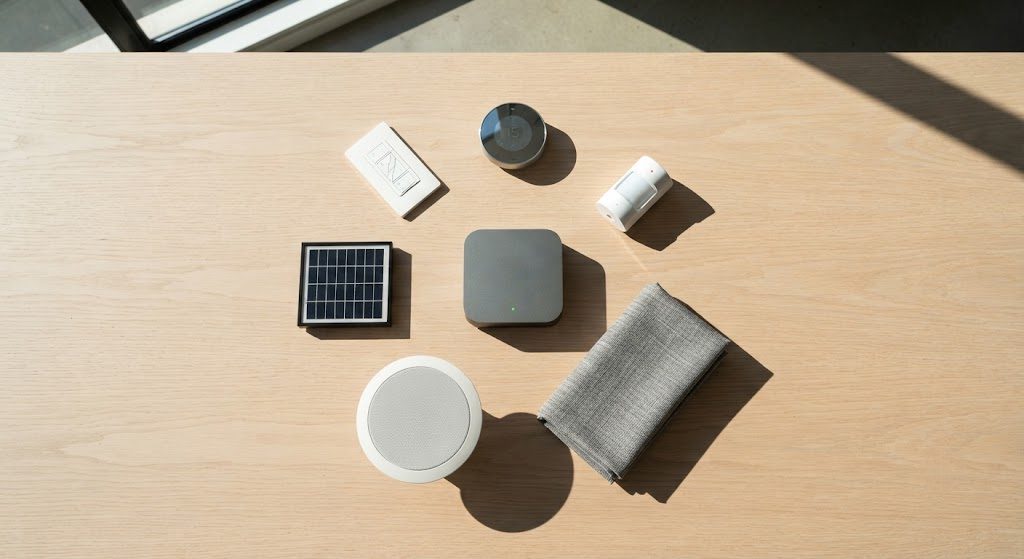
I've drawn this diagram on whiteboards, napkins, and the back of electrical plans at least 200 times. It always starts with six circles. Lighting. Climate. Security. Shades. AV. Energy. Then I draw lines from every circle to a seventh circle in the middle, labelled "Processor." The lines are what matter. Without them, you have six islands. With them, you have a brain.
The processor doesn't just send commands. It listens. A motion sensor in the hallway isn't just a security device—it's also an occupancy sensor that tells the HVAC someone's home. A motorized shade isn't just for privacy—it's a solar heat manager that tells the thermostat to ease off the AC. When these subsystems share data, the house starts making decisions before you have to.
What the Six Subsystems Actually Do
Before we talk integration, let's define what each subsystem brings to the table. This isn't a product list. It's a capability map.
Lighting
The most-used subsystem in any smart home. It covers switches, dimmers, keypads, and the loads they control—overhead fixtures, sconces, floor lamps, under-cabinet tape light. Tunable-white fixtures shift color temperature throughout the day. The key decision here is load control: do you put intelligence at the switch, at the breaker, or at the fixture? I'll save that debate for another post, but the answer shapes every wire pulled.
Climate
HVAC zoning, smart thermostats, remote temperature sensors, and air quality monitors. A single thermostat in the hallway is climate control for a studio apartment, not a house. Zone control means dampers in the ductwork, separate thermostats per floor or per room, and logic that cools only the occupied spaces. Add an outdoor temperature sensor, and the system can pre-cool a bedroom before the afternoon sun hits it.
Security
Door and window sensors, motion detectors, glass-break sensors, and the alarm panel. In an integrated system, the security sensors do double duty. An armed alarm at midnight triggers a scene: all interior lights off, exterior floods on, shades down, and the master bedroom keypad pulses a soft red indicator. No system-wide intrusion detection, no smart home. The security backbone is the house's awareness layer.
Motorized Shades
Roller shades, drapery tracks, and skylight blinds, all motorized and addressable. They manage daylight, privacy, and heat gain. Paired with an astronomical timeclock, shades lower automatically when the sun hits the west-facing glass. Paired with a wind sensor, they retract before a Santa Ana gust tears them off. These aren't window treatments—they're active building envelope components.
Whole-Home Audio
In-ceiling and in-wall speakers, distributed amplification, and streaming sources. Audio zones follow the same logic as lighting zones: a kitchen is one zone, a master suite another. The key integration point is the doorbell. When the doorbell rings, the audio system ducks and plays a chime through every speaker. If the security system triggers, it broadcasts a verbal alert. Audio becomes part of the house's voice.
Energy Management
Solar production monitoring, battery storage, EV charger scheduling, and whole-home energy metering. This is the newest subsystem in most homes, but it's the one that will matter most over the next decade. The integration play is load shedding: when the battery is low and the grid is peak-priced, the processor can dim lights by 10%, raise the AC setpoint by two degrees, and pause EV charging—all without you noticing.
How the Conversation Works in Practice
The real power emerges when you connect the dots. Here's a scene I've programmed into dozens of homes. It's called "Away."
The "Away" Scene: A Three-Second Symphony
You press a single button by the garage door on your way out. That button isn't a simple switch—it's a scene trigger on a Lutron keypad. The processor receives the event and runs a script. First, it tells every lighting circuit to shut off except the porch light and one living-room lamp set to 15%. Simultaneously, it commands all motorized shades to lower fully. It sets the HVAC to "Away" mode—four degrees above your normal cooling setpoint in summer. It arms the security system in "Away" state. It powers down all audio zones. If you have an EV, it checks the charge schedule and makes sure you're still set for off-peak charging. Total elapsed time: under three seconds.
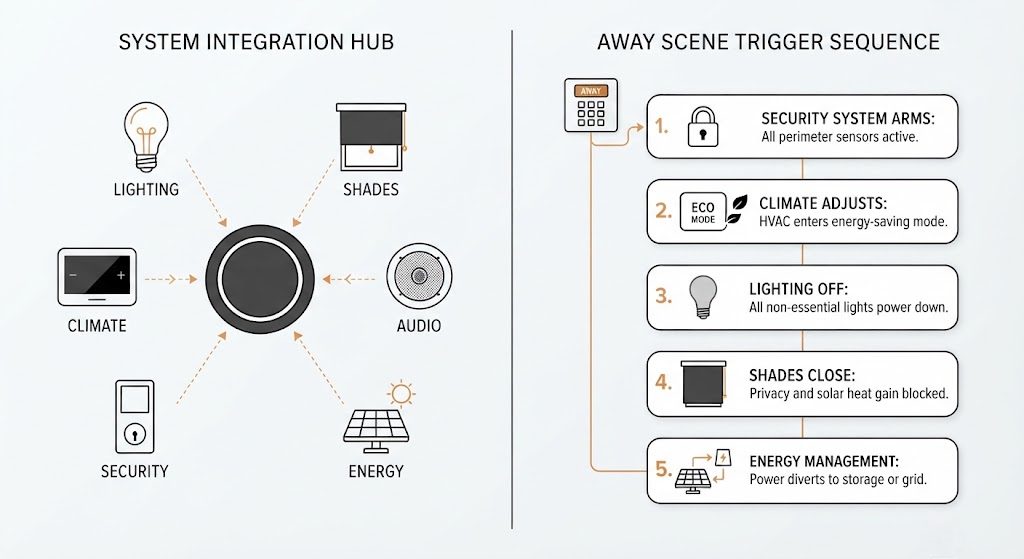
That scene runs every single day for years without anyone thinking about it. No voice command. No app. One button press, three seconds, the house takes care of itself. That's not a gadget. That's a system.
The work is in the programming, and the programming is only as good as the infrastructure. Next time, we'll go behind the wall to look at the wiring backbone that makes this kind of integration possible—because none of those six subsystems can talk if the nervous system was never installed.